
Welcome to the first blog post in our comprehensive blog series on “Streamlining Business Processes and Driving Digital Transformation.” In this series, we will explore the dynamic landscape of modern business operations and the critical role played by Business Process Management (BPM) and Digital Transformation Management (DTM) in achieving operational excellence and staying ahead in the digital era.
As organisations strive to remain competitive and agile in today’s rapidly evolving business environment, it is imperative to optimise their operations and embrace digital transformation. This blog series aims to provide you with valuable insights, practical strategies, and real-world examples to guide you on your journey towards streamlining business processes and driving successful digital transformation initiatives.
Part 1: Understanding Business Process Management (BPM)
In the first part of our series, we will delve into the fundamentals of BPM and its significance in enhancing operational efficiency. We will define BPM and highlight its benefits, methodologies, and the impact it can have on productivity, cost savings, and customer satisfaction. By exploring different BPM approaches and a case study, we will illustrate how an organisation has leveraged BPM to achieve remarkable improvements.
An Introduction to Business Process Management: Enhancing Operational Efficiency
In today’s competitive business landscape, organisations are constantly seeking ways to optimise their operations and achieve higher levels of efficiency. One approach that has gained significant traction is Business Process Management (BPM). BPM encompasses a set of practices, methodologies, and tools that focus on improving and streamlining business processes to drive operational excellence. In this blog post, we will dive into the fundamentals of BPM, exploring its impact on enhancing operational efficiency. We will discuss the benefits of BPM, popular methodologies used, and real-life case studies of successful BPM implementations that have resulted in significant improvements for organizations. So, let’s embark on this journey of discovery and unlock the potential of BPM for your business!
1. Understanding Business Process Management
Defining BPM
Business Process Management (BPM) is a discipline that focuses on optimising and managing business processes to enhance operational efficiency and achieve strategic objectives. Its purpose is to streamline operations, improve productivity, reduce costs, and enhance customer satisfaction. BPM aims to analyse, design, implement, monitor, and continuously optimize processes to eliminate inefficiencies, ensure standardisation, and drive innovation. By aligning processes with strategic goals, BPM enables organisations to achieve operational excellence, adapt to changing business needs, and maintain a competitive edge in today’s dynamic business landscape.
Benefits of BPM
Implementing Business Process Management (BPM) offers organisations a range of advantages, including improved productivity, cost savings, enhanced customer satisfaction, and increased agility. BPM optimizes processes, eliminates bottlenecks, and automates manual tasks, leading to improved productivity and efficiency. By identifying waste and streamlining workflows, organisations achieve cost savings and optimise resource allocation. Aligning processes with customer needs enhances service quality, responsiveness, and customer satisfaction, driving loyalty and retention. Additionally, BPM enables organisations to quickly adapt to market changes, customer demands, and regulatory requirements, fostering agility and competitive advantage. Through process visibility, monitoring, and continuous improvement, organizations achieve operational excellence and maximize their performance. BPM becomes a catalyst for success, enhancing productivity, reducing costs, delighting customers, and ensuring organisational agility in today’s dynamic business environment.
BPM Methodologies
AGILE AND LEAN METHODOLOGIES

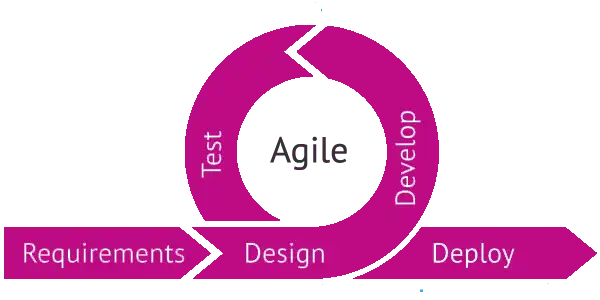
Popular BPM methodologies, such as Lean, Six Sigma, and Agile, offer structured approaches to process optimisation and operational excellence.
Lean focuses on minimising waste and maximising customer value through value stream mapping and continuous improvement. It is suitable for streamlining high-volume, repetitive processes.
Six Sigma aims to reduce variations and defects, utilising data-driven analysis and the DMAIC framework for quality improvement. It is applicable across industries, delivering significant quality enhancements and cost savings.
Agile emphasises collaboration, adaptability, and customer-centricity through iterative development cycles and constant feedback. Originally for software development, Agile has expanded to other business processes. Agile is ideal for projects requiring flexibility and rapid response to changing requirements.
Organisations can choose the most suitable methodology or combine elements from different approaches based on their specific needs and goals. Understanding these methodologies empowers organisations to optimise processes, reduce waste, improve quality, and adapt to dynamic market conditions.
2. The BPM Framework
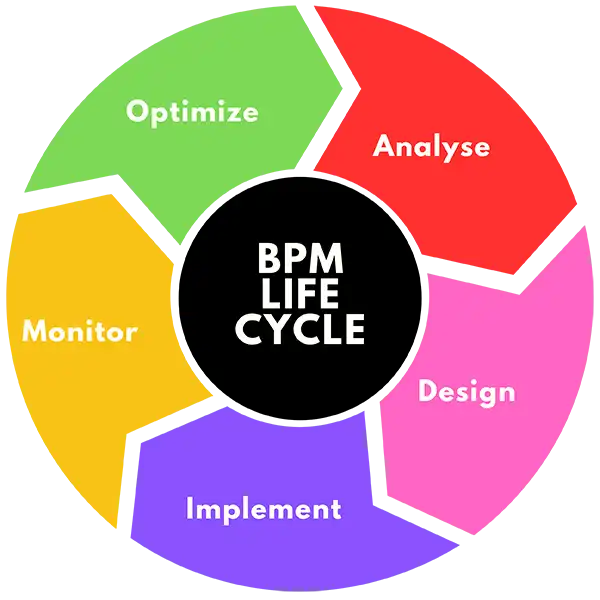
BPM Lifecycle
The BPM (Business Process Management) lifecycle consists of several key stages that organisations follow to effectively manage and optimise their business processes.
The first stage is process discovery, where existing processes are identified and documented. Next comes process analysis, where the identified processes are thoroughly examined to identify areas for improvement. Once the analysis is complete, the process design stage begins, involving the redesign and reimagining of processes to align them with organizational goals.
After the design stage, the processes are implemented, with necessary training and adjustments made to support the changes. The implemented processes are then continuously monitored to track their performance and identify any deviations or bottlenecks.
Finally, the process optimisation stage focuses on refining and improving the processes based on the insights gained during monitoring. This iterative lifecycle ensures that organisations continuously enhance their processes, driving efficiency, effectiveness, and overall operational excellence.
Process Mapping and Modelling
Process mapping and modelling are essential components of Business Process Management (BPM) as they provide visual representations of how processes operate within an organisation. Techniques like flowcharts, swim lane diagrams, and BPMN (Business Process Model and Notation) offer significant advantages. They enable stakeholders to understand and analyse processes more effectively by providing a clear visual depiction of the flow, decision points, and dependencies.
Process mapping and modelling facilitate communication and collaboration among teams, serving as a shared language for discussing and improving processes. They promote standardization and consistency by establishing a unified framework for executing tasks and reducing variations. Moreover, process mapping and modelling provide a foundation for process improvement initiatives, enabling organizations to identify inefficiencies and streamline processes for enhanced efficiency. They also support compliance and governance efforts by documenting processes and ensuring regulatory adherence.
Overall, process mapping and modelling techniques are invaluable in optimizing processes, promoting collaboration, and achieving operational excellence in BPM.
Process Automation
Automation plays a pivotal role in Business Process Management (BPM) by leveraging technology solutions like Workflow Management Systems (WMS), Robotic Process Automation (RPA), and Business Process Automation (BPA). WMS enables streamlined process execution, task assignments, and information flow, reducing delays and errors. RPA automates repetitive tasks, mimicking human actions and improving speed and accuracy. It frees up employees to focus on more strategic activities. BPA encompasses a range of automation technologies, integrating systems, applications, and data sources to optimise end-to-end processes.
The advantages of automation in BPM are significant. It eliminates manual errors, reduces process cycle times, and enhances productivity. Organisations can allocate resources more efficiently and gain better control over their processes. Automation improves visibility, allowing organisations to monitor performance and make data-driven decisions for continuous improvement.
However, successful automation requires careful

planning. Organisations must assess process suitability, complexity, and consider the impact on employees and stakeholders.
A strategic approach, including process redesign and change management, ensures effective adoption and integration.
Overall, automation technologies are essential for driving operational excellence in BPM. They enable organisations to optimize processes, improve efficiency, and adapt to the ever-changing business landscape, resulting in increased productivity, cost savings, and enhanced customer satisfaction.
Case Study: GFB (Bread Distribution)
GFB faced a significant challenge in their Proof of Delivery (POD) scanning and archiving process.
The manual photocopying of PODs for reference purposes required one full-time employee to dedicate approximately 10 hours daily. This labour-intensive and time-consuming task not only hindered productivity but also incurred substantial labour costs.
In order to address these challenges, GFB implemented Business Process Management (BPM) and Digital Transformation Management (DTM) strategies.
By integrating the scanning process into the driver debriefing process, they aimed to optimise the workflow and reduce the time and effort spent on scanning and archiving.
Through the adoption of BPM and DTM, GFB successfully transformed their scanning and archiving process, significantly reducing the time required from 10 hours to just 20 minutes.
This streamlined and efficient process allowed them to increase productivity, cut labour costs, and reallocate valuable man-hours to other functions within the organisation. The integration of BPM and DTM not only improved operational efficiency but also enhanced data accuracy and accessibility.
This case study showcases how GFB leveraged technology and process optimisation to achieve remarkable improvements in their scanning and archiving process, ultimately leading to increased efficiencies and cost savings.
Conclusion
Business Process Management is a powerful approach for organisations aiming to enhance operational efficiency and achieve sustainable growth. By embracing BPM and leveraging its methodologies and tools, businesses can unlock numerous benefits, including increased productivity, cost savings, and improved customer satisfaction.
Through a real-life case study, we have witnessed the transformative impact of successful BPM implementations. As you embark on your BPM journey, remember to tailor the methodologies to your organization’s unique needs and foster a culture of continuous improvement.
Embrace the power of BPM, and propel your business towards operational excellence and long-term success.